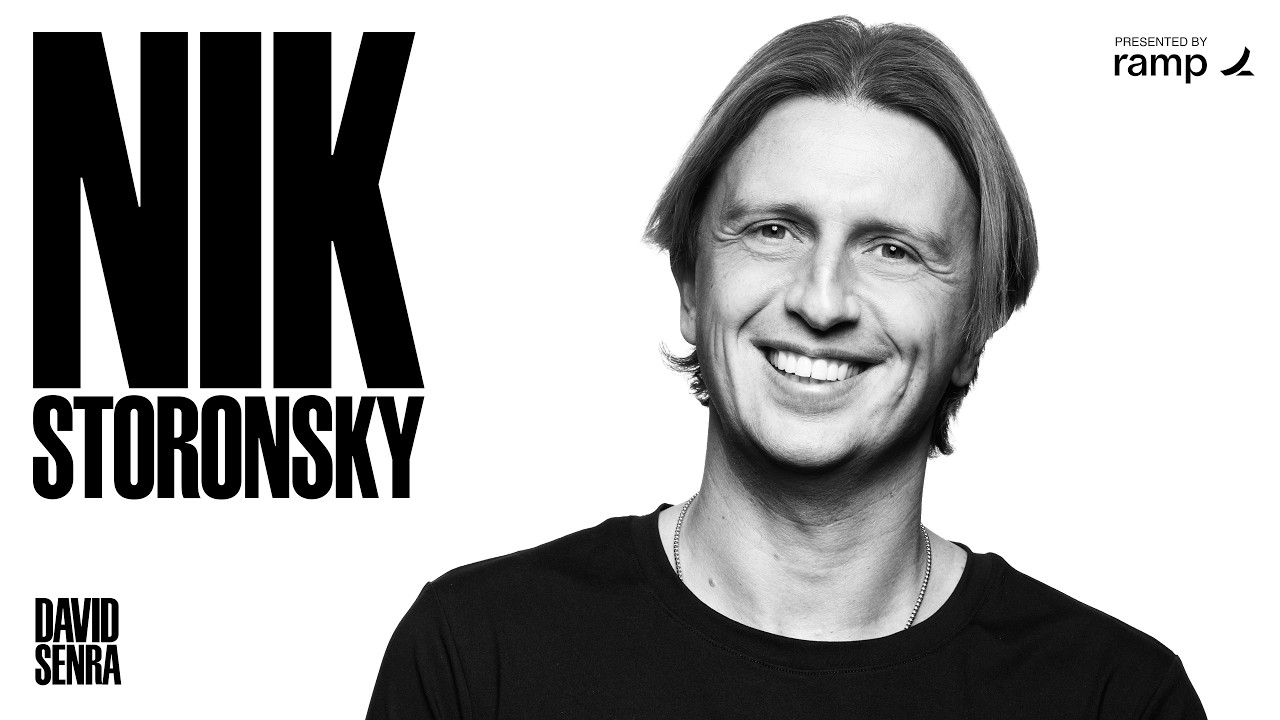
Nik Storonsky, founder of Revolut, describes building a global digital bank aiming to be number one in at least 100 countries, driven by an extreme competitive instinct he has had since childhood.
Competitive drive and ambition
Storonsky has been extremely competitive since age six, first in sports and olympiads, then in business; he feels “extremely pissed off” at being number two.
His ambition: build a global bank that provides better services at lower prices in every country, optimizing against fragmented local incumbents.
He views competition by focusing on self-improvement: “every day you need to be like almost 100% every day” and outcompete himself rather than watch rivals.
Compares his approach to Toby Lutke’s “corporate raider” mindset at Shopify — analyze how a new owner would improve every element.
Believes he wins because most incumbent banks are run by professional CEOs, not founders; professional CEOs optimize for job protection and play defense, while founders have 100% alignment with the company and play offense.
Professional CEOs lack technical depth, so they default to inaction; Storonsky combines deep technical understanding with operational intensity.
Revolut’s evolution and the banking license lesson
Started with a simple travel card offering interbank FX rates; expanded into credit, wealth, trading, crypto, business accounts, and non-financial services (stays, eSIMs).
Now live in ~38 countries with banking licenses in most; adding 10–15 new markets every 1–2 years.
Initially avoided a banking license (took 3–4 years) in favor of faster e-money licenses; reached 7–8 million UK customers before applying.
Regulators viewed the large unlicensed entity as riskier; it took nearly 5 years to get the UK license.
Lesson: a banking license is essential to capture prime customers (salaries, wealth, trust); without it, fintechs stay niche (early adopters only).
Ireland proves the ceiling: 80% adult penetration because Revolut is a licensed bank competing against four bad incumbents in a small, diaspora-heavy market.
UK, France, Spain show 20–40% penetration; the license unlocks the mass market.
Building the “machine”: organizational structure and bet process
Views the company as a machine with inputs (people, structure, product decisions) producing outputs (great products); constantly observes, identifies bottlenecks, builds new “muscles” (reg affairs, recruiting), and iterates.
Borrowed from trading: risk management, quantification, and KPIs to kill politics; everything measured by objective numbers.
“Bets” process: small independent teams (≤10 people: 3–4 backend, 2–4 frontend, designer, product owner, sometimes data scientist/ops) build a product in 9–18 months.
Track gross profit growth monthly; top ~25% of bets get doubled down (more teams, become departments/P&L lines); bottom 25% sunsetted within 18 months.
Storonsky doesn’t trust his own product intuition; uses algorithmic discipline instead.
AI is shrinking bet teams: one developer can now do full-stack + data science; target team size becoming 2–3 people.
Already automated 90% of customer support; engineering speed up 30%; translation and cross-selling via LLMs.
Ultimate goal: full-stack AI employees with email, Slack, calendar, back-office access that can join calls and execute work.
Management philosophy: self-guided missiles, no middle managers
~50 direct reports; speaks to individual contributors deep in the org.
Hires “self-guided missiles”: brilliant people who self-identify and reach goals without direction.
Categorizes talent: self-guided (set + hit goals), good (need goal, then execute), average (need weekly iteration), below average (miss even with help).
Fires average and below; keeps management time near zero per report.
Believes empathy for individuals must be secondary to winning; if executives are liked by their teams, they may be too soft.
Eliminates managers who only pass information up/down without adding innovation or direction.
Standardizes tools and processes across teams; when one team innovates (e.g., using LLMs to generate live designs from code-based design system 3–4x faster than Figma), spreads it company-wide immediately.
Marketing: seven years organic, then scientific blitz
Zero paid marketing for first seven years; COVID crushed travel-dependent revenue 70%, forced optimization.
After banking license, realized trust is the barrier for branchless banks; arbitrage physical-world impressions (cheaper than digital).
Bought ~50% of European airport ad inventory; launched “Rev experience” stores (Apple-store-like) in high-footfall locations to generate physical impressions and trust.
Investors and Quantum Light VC fund
Early European VCs imposed onerous terms (liquidation preferences, board seats, reduced founder voting); viewed themselves as value-add advisors despite never building companies.
Storonsky fought investors who pushed bad advice: hire experienced executives (failed — kept only 2 of 50+ in first five years), fire his best “hardcore” operator.
Experienced executives have passed their prime, carry negative selection bias (truly great ones aren’t on the market), and misalign with startup speed.
Removed all VCs from board in every round; keeps only operators who have built businesses.
Launched Quantum Light fund (separate from Revolut): statistical/ML-driven investing, equal check sizes, 30–40 companies per fund.
Fund I: $250M, Series B, 56% IRR; Fund II: $500M, Series C; models analyze partner-level track records, partner age (best 30–40), and other signals.
Adds value via operational playbooks (hiring, performance management, product expansion) and enterprise distribution (Revolut as customer/channel).
Moonshot bets and competitive moat
Goal: generate massive cash flow from banking to fund moonshots outside financial services (e.g., own LLMs, data centers).
Already built Pragma: transformer model trained on 30M daily transactions (billions total) for fraud, credit, investment use cases.
US launch pitch: global accounts (Europe, Australia, instant cross-border), better UI, cheaper, subscription/transaction/commission revenue mix vs. credit-heavy incumbents.
Core moat: single standardized ledger and configurable software stack across countries; no legacy system spaghetti; economy of scale lets them underprice local banks.
Institutional knowledge (product, marketing, compliance) reapplied in each new market → “unstoppable machine” over time.