Justin Mateen co-founded Tinder in 2012 and now runs JAM Fund, a ~$300–400 million venture fund investing in high-growth tech startups. This episode explores how he picks founders, evaluates deals, and builds pattern recognition as an investor, while also touching on his Tinder founding experience, his philosophy on money and motivation, and a lighter segment involving cornhole and hot sauce.
What Justin looks for in founders
Founders who can see the future and have an irrational drive. He describes strong founders as “abnormal” in the sense that they know what needs to happen and are unusually motivated to make it happen.
Age range preference: roughly 22–35. At 22 you have some work experience but are still naive enough to take big risks, which he encourages.
A chip on the shoulder is a major plus. He looks for founders whose personal experiences have given them an exceptional, almost unstoppable motivation.
Example: Curative founder Brad Turner. Grew up dirt poor in Nepal with no power, tutored for money, his father sold something valuable to get him a flight to New York. Put himself through school, worked for George Soros, bought his family a home, then started a company. Justin’s previous investment in Turner’s earlier company had a $30 million term sheet pulled in the final hour, yet most investors wouldn’t back him again. Justin became the first investor in his next company. In February 2020 Justin asked Turner to consider pivoting to COVID testing; Turner found a lab in San Diego and Curative’s COVID-19 test kits became widely used almost overnight. Curative now powers a large percentage of COVID tests in the US.
Justin’s investing philosophy
He likes betting on the second mover in a massive, indefensible space. Rather than paying a massive premium for a perceived monopoly, he’d rather invest in a huge market (e.g., grocery at ~$800 billion/year) where execution and speed matter more than being first. A couple of years’ head start doesn’t mean much if the space isn’t defensible.
He does not believe in a direct correlation between risk and reward. He tries to invest where he has more information or deeper understanding than the average person, so the risk is lower and the edge is higher.
Pattern recognition is central. Doing deals is generative: each one sharpens his ability to spot opportunities. He uses the metaphor that there’s no such thing as a $20 bill on the ground because someone picks it up immediately — you shouldn’t wait six months to see what the LTV-to-CAC ratio looks like before acting.
On company failures: The number one reason companies fail is running out of money — they can’t reach profitability or a point where investors feel confident. He advises founders to raise a bit more capital than they need as a backup. The second reason is not being able to attract the right talent; founders must surround themselves with people better than themselves.
On ownership vs. size: He’d rather own 1% of a $10 billion company than 10% of a $100 million company — not just because of the math ($100M vs. $10M), but because the larger business is safer and more likely to have real, durable value.
On market timing: During COVID he was aggressively buying. He argues that if you’re a long-term thinker investing in companies you believe will succeed over time, you don’t need to time the floor perfectly. He sees Jerome Powell’s Fed actions as having put a de facto floor under equities. He still believes some companies are overvalued and others undervalued.
Co-investing and admiring Peter Thiel
Peter Thiel is an investor he particularly admires and co-invests with. Thiel is a thought leader who assesses individuals based on the quality of their thinking. (Justin also notes, humorously, that he admires him in part because the host works for Thiel.)
What motivates founders — and what Justin needs to hear
He often asks founders, “What motivates you?” as a proxy question. The content of the answer tells him something about the person.
Very few founders say financial gain first, and that’s fine — but it should be in the top three or four reasons. If they’re not thinking about the bottom line and building a financially sound business, maybe they should start a charity instead.
Money as status symbol is bad; money as freedom is good. He distinguishes between rent-seeking wealth and value-creating wealth, and argues that investing well in high-growth venture companies is one of the most beneficial things you can do for society — it’s a “double whammy” of good returns and accelerating something new into existence.
Tinder experience and moving forward
He co-founded Tinder in 2012 with Sean Rad, funding most of it themselves aside from engineers from Hatch Labs (IAC’s incubator). He and Rad initially had a healthy equity split.
Once Tinder’s momentum became clear, IAC (the parent company) flipped the equity percentage on him. He was going through a bad breakup with someone who worked at Tinder, and he feels that personal situation was used as a kind of nuclear negotiation tactic by IAC to oust him and gain leverage.
He thinks about it often but chooses to keep moving forward. He went through a period of trusting very few people, realized that was unhealthy, and adjusted. He also pushes back on media narratives, noting that even well-intentioned outlets are often arbitraging eyeballs and monetizing ads, and he respects outlets that simply seek the truth.
Lighter closing segment
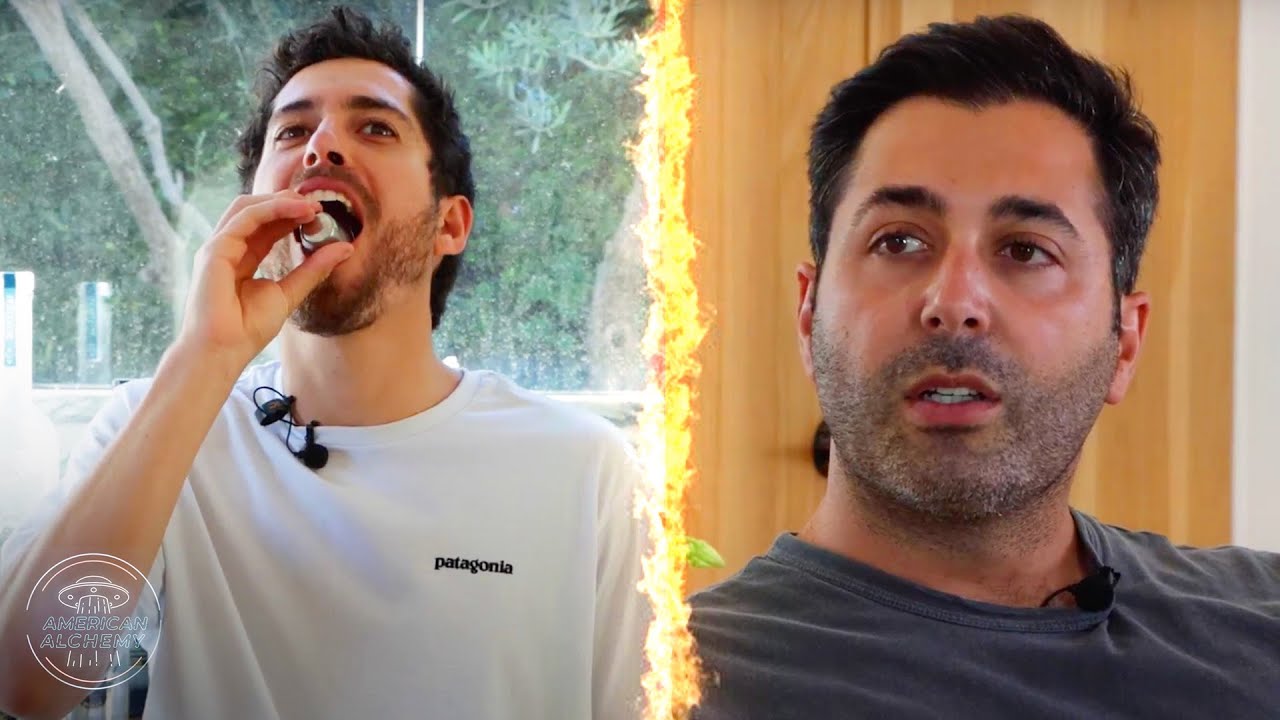
After a long conversation that made them miss lunch, Justin and Jesse played cornhole, with the loser required to take a shot of the hottest hot sauce from the show Hot Ones. Jesse lost, took the shot, felt like he wanted to run out of his skin, stripped off his clothes, and jumped into Justin’s pool.
They closed the episode with a session of holotropic breathwork, which Justin said made him feel “like a whole new person” and thanked Jesse for afterward.