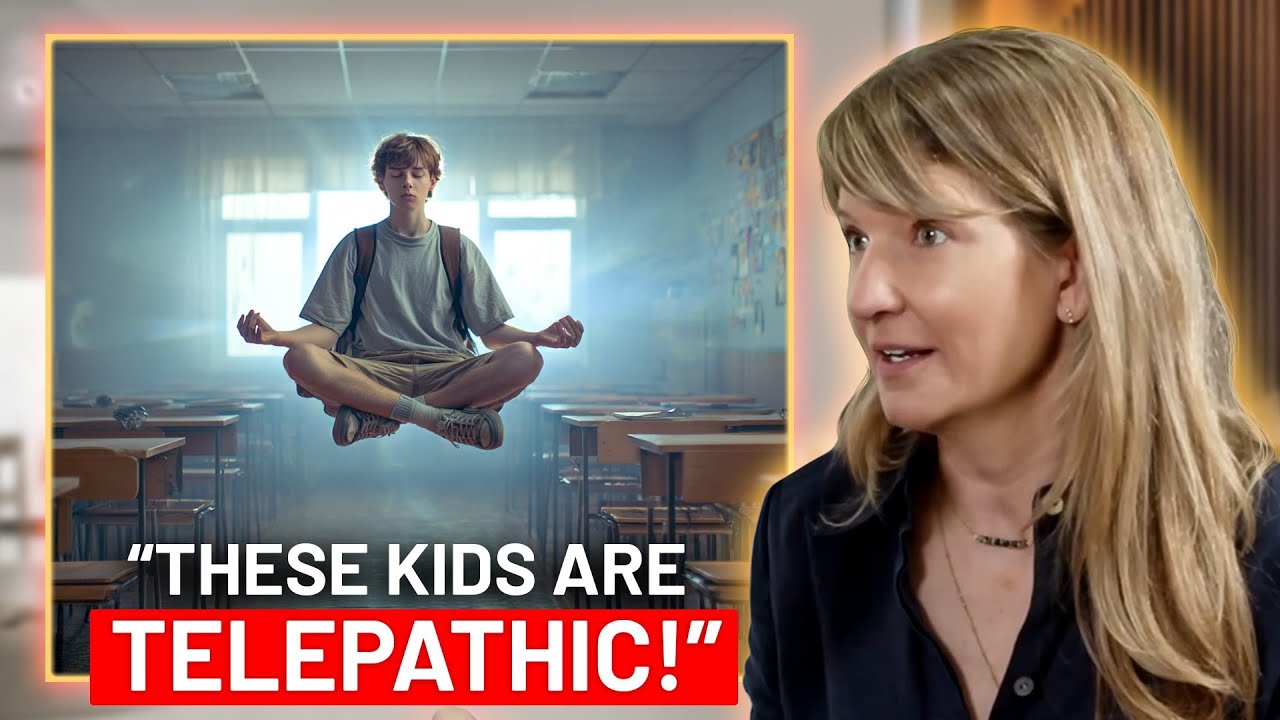
- Ky Dickens is a documentary filmmaker who created The Telepathy Tapes, a series documenting non-speaking autistic children who appear to possess telepathic abilities, and who works alongside Harvard-trained neuroscientist Dr. Diane Powell to investigate these phenomena under controlled conditions. The episode explores how these children—often dismissed by doctors as intellectually absent—can read their parents’ thoughts, perceive images their parents are viewing, and even communicate telepathically with each other through a shared mental space they call “the hill.” The conversation spans the scientific, spiritual, and social dimensions of this research, including the controversy around spelling-based communication methods, the persecution of researchers who study psi phenomena, and the broader paradigm shift this work suggests about consciousness, love, and human potential.
The Children and Their Abilities
-
Mia, a young girl from Mexico, was the first child Ky tested under controlled conditions in a rented house in Glendale, California. Mirrors and TVs were removed, cameras installed, and a divider placed between Mia and her mother. Mia was blindfolded while her mother viewed random numbers, images, or colored objects, and Mia identified them all correctly—repeatedly and without error. She required only a light touch on her shoulder or head to communicate, which she spelled out on a letter board.
- Skeptical crew members, including Ky’s DP Michael, tested the blindfolds themselves and confirmed they were impenetrable. The idea that Morse code or subtle cues could explain the results was dismissed as more implausible than telepathy itself.
- Mia’s family, devout Catholics in Monterey, Mexico, were initially worried their neighbors might view the ability as evil. The children themselves consistently describe it as a spiritual gift from God.
-
Akhil, a young man in New Jersey, can read his mother Manisha’s thoughts across a room with no physical contact. His mother describes it not as simple telepathy but as a shared consciousness—a merging. She demonstrated this by writing a word, crossing it out, and beginning a new one; Akhil would start spelling the next word before she had even finished crossing out the first.
- Akhil has also demonstrated remote perception: his mother once watched a movie about an amputee athlete while Akhil was upstairs, and when she came to show him, he already knew the story—including that the man had no leg and was in the Special Olympics.
-
Houston, a young man in Atlanta, was nonverbal until age 17, when he suddenly looked his mother Katie in the eyes and said “Mama” and “I love you”—the first words he had ever spoken. Katie, a single mother of five who had been told Houston would never communicate, discovered spelling through RPM (Rapid Prompting Method). Houston went on to demonstrate rich knowledge of American history, an ability to sense the energy of crystals and stones, and telepathic abilities including reading thoughts and perceiving what others were doing remotely.
- Houston coined the term “the hill” to describe a telepathic chat room where non-speakers communicate with each other mentally, regardless of physical location.
-
John Paul (“JP”), a 6’8” gentle giant in Atlanta and Houston’s close friend, communicates on the hill and has a girlfriend named Lily with whom he shares a deep telepathic bond. His mother Libby is a speech-language therapist who was essentially told that spelling was forbidden for her son. JP’s story culminates in episode 9 with what Ky describes as profound evidence of the afterlife—so moving that Ky’s previously skeptical father called to say it had completely changed his view of death.
-
Amelia, a 10-year-old in Wisconsin, is remarkable for both her telepathic abilities and her apparent capacity to access knowledge through non-conventional epistemic pathways. She has read and translated Hebrew, identified hieroglyphics she had never been taught, and knows multiple languages. When tested, her teachers and therapists carefully ensured they themselves did not know the answers, so Amelia could not simply read their minds—she still got them right. She attributes her knowledge to God, angels, and spiritual teachers including a rabbi and the Dalai Lama. She also wrote a poem identifying herself as a unicorn—an “ugly horse” that people thought wasn’t smart—revealing how she perceives others’ unspoken judgments of her.
-
Josiah, a young boy, began spelling spiritual messages from a very young age, including communications from a deceased great-aunt (“Auntie”) he had never been told about. He later began relaying accurate, private information about author Max Davis—including details about construction noises at Davis’s home, a nap Davis took, and the title of a chapter Davis was writing—all without any conventional channel of communication. Davis initially thought it was a hoax but eventually became a believer.
The Hill: A Telepathic Shared Space
- Multiple non-speaking autistic individuals across different states and countries describe accessing a shared mental space they call “the hill”—a telepathic chat room where they communicate with each other mind-to-mind.
- Houston and John Paul, who live in Atlanta, have a relationship built partly on the hill. John Paul also had a pre-existing telepathic relationship with Zahari, a blind adoptee he had never met in person—when Zahari walked into John Paul’s house, they greeted each other as old friends.
- Reports of the hill come from diverse sources: a minister running a special needs youth group at a megachurch, a teacher in Chicago, and Arthur Golden, whose non-speaking son Ben is part of a hill community in an Ultra-Orthodox community in Israel. Hills have also been reported in Arizona and Florida.
- It is unclear whether there is one hill or many, or whether it is a collective consciousness or a separate mental space. Ky and Dr. Powell hope to design controlled tests for the film to validate communication between non-speakers in different locations via the hill.
Spelling and the Communication Controversy
- Non-speaking autistic individuals typically communicate by pointing to letters on a letter board or iPad—an umbrella term Ky uses is “spelling.” This includes methods like Facilitated Communication (FC), Rapid Prompting Method (RPM), and Spelling to Communicate.
- The process often begins with physical support (a touch on the shoulder or head) and gradually fades as the individual gains body awareness and control. Many non-speakers report not initially knowing they had bodies or fingers.
- ASHA (American Speech-Language-Hearing Association) has declared spelling to be pseudoscience and does not recognize it as a valid form of communication. This has enormous consequences: non-speakers are denied communication tools in classrooms, workplaces, and social settings.
- Ky draws a direct parallel to the historical suppression of Braille and sign language. Louis Braille’s system was dismissed as pseudoscience, and braille books were locked away by school authorities. Sign language was not accepted in schools until relatively recently. The same pattern of institutional resistance is now playing out with spelling.
- Many parents and advocates view ASHA’s position as a profound human rights violation—silencing individuals who have no other way to express themselves.
Dr. Diane Powell’s Research and Background
- Dr. Diane Powell is a Harvard-trained neuroscientist and psychiatrist who began studying autism and savant abilities after meeting Oliver Sacks in 1986. She became interested in telepathy in autistic savants after encountering early data suggesting high rates of ESP in this population.
- Her inbox is filled with emails from parents around the world describing telepathic experiences with their non-speaking children—families who are isolated, confused, and desperate for explanation.
- She emphasizes the need for rigorous controlled testing (Faraday cages, blindfolds, partitions) while also recognizing the paradox of testing individuals who are easily overwhelmed by unfamiliar environments, bright lights, and sensory overload. She and Ky discuss creating a comfortable, loving testing environment with carpets, crystals, candles, and familiar blankets.
- Dr. Powell’s medical license was revoked after she published her book The ESP Enigma, which presented sound scientific evidence for ESP. She had to undergo psychological evaluation to get it back. The experience traumatized her.
- She was close friends with John Mack, the Harvard psychiatrist who studied alien abduction experiencers and was persecuted by his institution. After Mack’s death, Dr. Powell was urged by attendees at his memorial to carry on his legacy. She later purchased a house in Oregon that was built on Mack’s birthday—a synchronicity she found deeply meaningful.
The Science and Theory of Transmission
-
Transmission Theory of Consciousness: Dr. Powell and Ky discuss the model, associated with William James and Aldous Huxley, that the brain is more like a radio receiver than a generator of consciousness. Just as damaging a radio’s components stops the music but doesn’t destroy the broadcast signal, brain injuries may disrupt the expression of consciousness without eliminating the consciousness itself.
- Kim Peek (the inspiration for Rainman) is a key example: he had no corpus callosum, his skull bones were separated, and his brain was largely filled with cerebral spinal fluid—yet he could recite 12,000 books word for word. This challenges the materialist model that memory and knowledge are stored locally in brain tissue.
- Lucille Ball reportedly heard music through dental fillings that acted as radio receivers—a phenomenon called bone induction. Dr. Powell had a similar patient whose dental fillings picked up radio signals; the signals stopped when the fillings were removed. Andre Puharich documented a similar case involving metallic ore embedded in a man’s teeth.
-
Scalar Physics: Ky and Dr. Powell discuss the possibility that scalar waves—longitudinal electromagnetic waves allowed by the original Maxwell equations but dropped from modern physics for mathematical convenience—could be involved in telepathic transmission. Constantine Meyl, a German physicist, studies scalar helical waves and their effects on biological systems. Ky notes that extended electrodynamics is discussed by credible government and Navy sources and may soon be rediscovered by mainstream science.
-
Caudate Nucleus and Putamen: Dr. Powell highlights these brain structures, located near the ventricles and lined with cilia-containing cells, as potentially central to consciousness and psychic abilities. The caudate and putamen are more neuronally dense in people who display strong intuitive or psychic abilities, and this trait appears to be hereditary. Autistic individuals and schizophrenics both show differences in the caudate, suggesting a neurological basis for experiences that are often pathologized.
The DSM and the Medical Model
- Both Ky and Dr. Powell are critical of the DSM (Diagnostic and Statistical Manual of Mental Disorders), which they view as a tool created for insurance companies and lawyers rather than a description of reality. It labels syndromes superficially without investigating underlying causes—biological, psychosocial, or spiritual.
- Dr. Powell notes that many conditions labeled as psychiatric disorders can have medical causes (hypercalcemia, hyperthyroidism) or spiritual crises as their root. She was trained at Johns Hopkins to look for multiple causes of any syndrome.
- She points out that many people diagnosed as schizophrenic may actually be experiencing genuine psychic phenomena—a possibility that mainstream psychiatry is not equipped or willing to consider.
Love, Consciousness, and the Paradigm Shift
-
A recurring theme is that love and emotional connection are central to telepathic abilities. The parents’ unconditional love for their non-speaking children, and the children’s love for their parents, creates the conditions under which these gifts manifest most strongly.
- Non-speakers frequently say they don’t just hear thoughts—they feel feelings. One speller said that when people can’t process their own emotions, the non-speakers do it for them. This aligns with research on emotional contagion, attachment theory, and the profound sensitivity children have to their parents’ internal states.
- Ky notes that telepathy would not have seemed extraordinary to most of human history—it is only the modern materialist paradigm, which insists that only measurable phenomena are real, that makes it seem paranormal. In India, Ian Stevenson was told by locals: “Why are you trying to prove reincarnation? We already know it’s real.”
- The non-speakers’ core message is one of love and unity—a message that echoes the deepest teachings of the world’s religions but is rarely practiced. Ky argues that if we truly understood that our thoughts and feelings become manifest in the world, and that we are constantly “audited” by the consciousness around us, we would become more compassionate and forgiving.
-
Random Event Generator (REG) research from the Princeton parapsychology lab shows that a person’s heart-centeredness—their emotional coherence—is correlated with their ability to influence quantum-level random events. Ky describes this as essentially a new religious movement: the mandate is to go within, purify your intentions, and you gain the ability to affect the material world.
-
Ky recounts a personal experience of receiving what she believes was a telepathic communication from Houston in a dream—a vision of bringing non-speakers together on a metaphorical hill. When she asked Houston through his mother, he confirmed he sends her images at night. This shifted her understanding of her own creative process: many of her ideas for the film may be coming from the non-speakers themselves.
Social Isolation and the Call for Inclusion
- Parents of non-speaking autistic children face profound social isolation. Katie described being asked to take Houston to a quiet room at church, being stared at in public, and constantly worrying about affecting “normal people.” The stigma around behaviors like stimming and vocalizing makes everyday activities—going to a restaurant, flying on a plane, attending church—extremely difficult.
- Ky calls for practical action: businesses can host “autism nights,” schools can create safe rooms at events, and individuals can offer to spend time with non-speakers in their community—going for walks, swimming, or simply hanging out—to give parents a break and provide the non-speakers with friendship and social connection.
- She emphasizes that non-speakers want and need friendship, community, and love just like everyone else. The relationship is deeply rewarding for both sides.
Protecting Researchers and Shifting the Paradigm
- The persecution of researchers like Dr. Powell and John Mack illustrates the threat that psi research poses to the materialist paradigm. Revoking a scientist’s license for publishing sound research on ESP is not a sign of strength but of insecurity—if the research were truly worthless, there would be no need to suppress it.
- Ky encourages listeners to be open-minded skeptics rather than dogmatic ones. Closed-minded skepticism is indistinguishable from religious fundamentalism. The truth may be very different from what the current paradigm assumes.
- The current paradigm is showing signs of exhaustion—Ky compares it to the declining marginal returns at the end of a Kuhnian paradigm shift, pointing to string theory’s lack of progress and the growing body of undeniable anomalous data. Academia, he argues, is playing catchup, constrained by reputational optics rather than genuine inquiry.
How to Help
- Share The Telepathy Tapes to help shift public awareness and destigmatize both telepathy and spelling-based communication.
- Advocate for spelling in schools: Write to ASHA, talk to school districts, and push for spelling to be recognized and funded. ABA therapy is not the solution, according to every parent Ky has worked with.
- Support non-speakers and their families in your community: offer friendship, create inclusive spaces, and provide respite for caregivers.
- Support Ky’s film project, which aims to fund rigorous controlled testing of telepathic abilities in a comfortable, loving environment—and ultimately to create a community space (a “non-speakers’ center”) where these individuals can thrive.