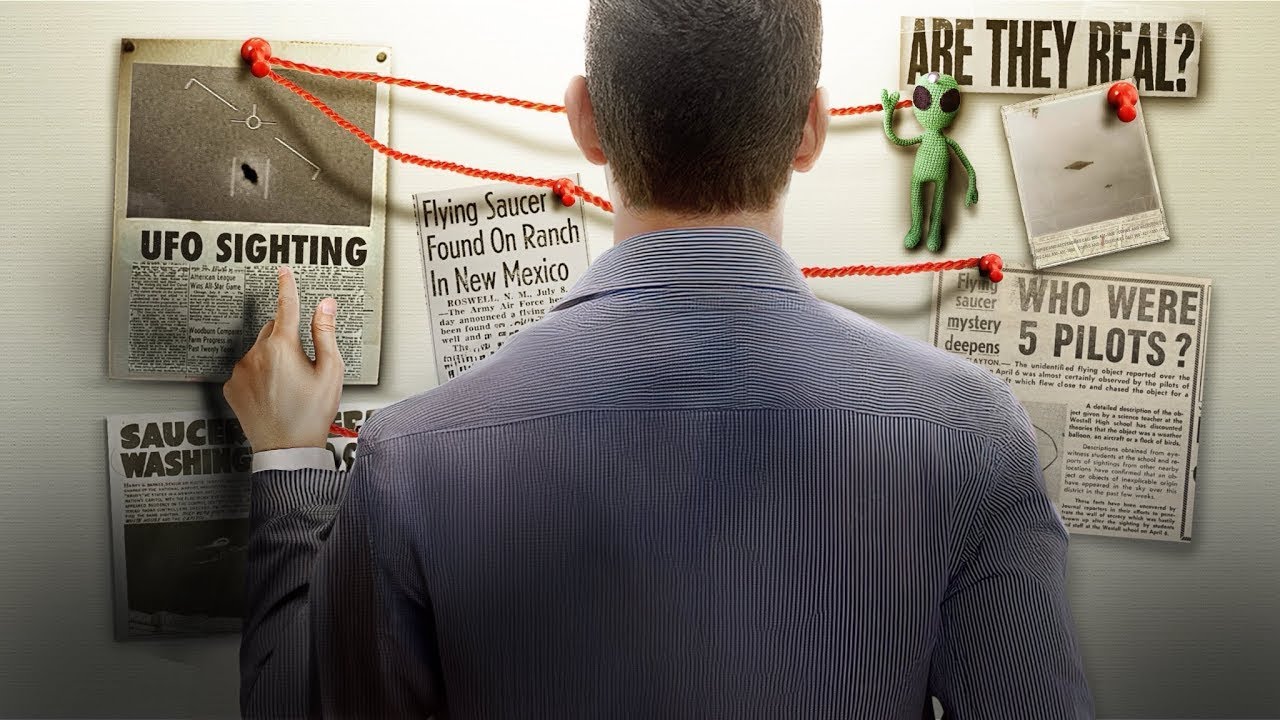
James Fox is a documentary filmmaker widely regarded as one of the most important figures in UFO documentation, with a career spanning decades and including films such as Out of the Blue (2003), I Know What I Saw (2014), The Phenomenon (2020), and Moment of Contact, as well as an upcoming program focused on crash retrieval and government secrecy.
He approaches UFO investigations with a juror’s mindset: presenting evidence to skeptics by emphasizing credible testimony, multiple witnesses, radar data, and physical documentation rather than anecdote alone.
His work has played a key role in shifting public and political discourse around UFOs (now often termed UAPs), especially through high-profile interviews with figures like Senator Harry Reid and David Grusch.
How James Fox Got Into UFOs
In his early 20s, Fox dismissed UFOs as absurd until a close friend introduced him to the Roswell incident.
A mentor at his production job in San Francisco challenged his skepticism, prompting him to investigate.
After attending conferences and meeting military insiders, he committed to making documentaries on the topic despite warnings from his journalist father that it was a “dead-end street.”
The Robertson Panel and the Policy of Ridicule
In 1953, the CIA convened the Robertson Panel, which recommended systematically downplaying UFO reports through media ridicule.
This policy became embedded in Project Blue Book, the Air Force’s public-facing UFO investigation, which functioned more as a debunking operation than a scientific inquiry.
Fox argues this campaign successfully stigmatized the topic for decades, discouraging serious research and witness testimony.
Hidden Government Programs Beyond Blue Book
Evidence suggests Project Blue Book was a “dog and pony show” while a parallel, highly classified program conducted real investigations.
A document found by Jacques Vallee in Dr. J. Allen Hynek’s files described an ultra-secret, well-funded scientific effort involving top physicists like Freeman Dyson, Edward Teller, John Wheeler, and possibly J. Robert Oppenheimer.
This program operated outside public oversight, with findings never shared with Blue Book or the media.
Oppenheimer, Majestic 12, and UFO Secrecy
Oppenheimer’s 1954 security clearance hearing (“kangaroo court”) may have been less about communist ties and more about his knowledge of UFOs.
Gordon Gray, who led the hearing, was allegedly part of Majestic 12 (MJ-12), a secret group formed under Truman to manage UFO-related information.
Transcripts contain strange references to a “Buck Rogers universe” and Oppenheimer’s repeated claim that “a lot happened between ’45 and ’49”—a period coinciding with multiple alleged crash retrievals.
James Fox’s Investigative Approach
Fox suspends judgment when evaluating cases, prioritizing evidence over belief.
He structures his films like legal arguments aimed at persuading skeptics, using multiple eyewitnesses, official documents, and corroborating data.
He avoids credulity, recognizing that extraordinary claims require rigorous investigation—not blind acceptance.
The Phenomenon’s Physical and Psychic Dimensions
Fox concludes the UFO phenomenon is real, global, and exhibits both physical and psychic properties.
Witnesses consistently describe craft performing impossible maneuvers: instantaneous acceleration, right-angle turns at high speed, no sonic booms, and silent operation.
Many close encounters involve telepathic communication, suggesting a non-physical or consciousness-linked aspect to the phenomenon.
Face-to-Face Encounters and Military Testimony
Fox includes a controversial 1994 Nellis Range encounter in his upcoming program, where Air Force personnel allegedly interacted with non-human beings near a landed craft.
Though unverified, he presents it because the witnesses are named, the location and date are specific, and dismissing it outright hinders further inquiry.
Similar accounts exist, such as Colonel Charles Hall’s claims of Nordic-type extraterrestrials hosted at a facility near Area 51.
The Holloman Air Force Base Landing Case
Fox investigates a alleged 1964 landing at Holloman AFB, New Mexico, where beings reportedly emerged from a disc and met with military officials.
Filmmaker Alan Sandler claimed to have seen black-and-white footage of the event at Norton Air Force Base before it was confiscated by “men in suits.”
Paul Shartle, who showed Sandler the film, died in a suspicious head-on collision years later.
Despite lack of physical proof, Fox finds the consistency and credibility of testimonies compelling.
The Varginha, Brazil UFO Incident (1996)
Fox initially dismissed the Varginha case—where residents reported crashed UFOs, live aliens, and military involvement—as too outlandish.
After five trips over 12 years, he became convinced it occurred, interviewing doctors, police, military personnel, and civilians.
Key details include:
A sulfur-like odor emanating from the beings.
One alien died after being manhandled by a soldier who later fell ill from exposure.
Hospitals closed wings due to the smell; X-rays were performed.
Witnesses faced threats, surveillance, and intimidation, including phone calls from military bases warning them about “an American filmmaker.”
Physical evidence may still exist: two forensic pathologists recently came forward with biological samples from the case.
Current State of UFO Disclosure
Fox believes momentum toward disclosure is irreversible, driven by congressional hearings, whistleblowers like David Grusch, and bipartisan support.
He notes pushback from intelligence communities but argues the “genie is out of the bottle.”
While full technological disclosure is unlikely, he expects official acknowledgment of non-human intelligence by 2030.
The Wilson Memo and Crash Retrieval Programs
The Wilson Memo describes Admiral Thomas Wilson’s frustration upon discovering a corporate-run crash retrieval program with no government oversight.
Despite finding 400–800 personnel working on non-human craft, he was denied access and told to “kick rocks.”
Fox spent six months verifying the memo’s authenticity through sources at Los Alamos and the Senate Armed Services Committee.
He considers it credible and central to understanding hidden reverse-engineering efforts.
Disinformation in the UFO Community
Fox warns against figures who make definitive claims about alien races or government programs without evidence.
He suspects some high-profile names (e.g., John Alexander, Richard Doty, John Lear) may be involved in disinformation, either deliberately or as useful idiots.
Tactics include:
Publishing fringe theories in low-credibility outlets (e.g., Daily Mail, National Enquirer).
Mixing truth with absurdity to discredit legitimate cases (e.g., adding alien contact to the Rendlesham Forest incident).
He cites the Condon Report (1969) as a deliberate debunking effort masked as science, influenced by figures tied to nuclear secrecy and intelligence.
UFOs and Nuclear Sites
A recurring pattern shows UFO activity near nuclear facilities: missile silos, carrier groups, and power plants.
Robert Hastings documented numerous cases where UFOs disabled nuclear weapons systems.
In 2010, a Tic Tac UFO caused a power outage at F.E. Warren Air Force Base, confirmed off-record by missileers.
Fox maps these incidents and finds clustering around Trinity site and other nuclear zones, suggesting strategic interest in human weapons.
Personal Experiences and Psychic Phenomena
Fox had a spontaneous psychic experience while editing Out of the Blue: he visualized a colleague keying his car hours before confirming it physically.
He interprets this as evidence of expanded human perception, possibly linked to brain structures like the caudate nucleus involved in intuition.
He remains cautious about personal anecdotes, preferring to base his views on documented evidence rather than subjective experiences.
Challenges in UFO Research
High-quality cases are hardest to investigate because witnesses fear retaliation.
In Varginha, even those without evidence were terrified; those with footage were summoned to military bases.
Fox spent years building trust, often traveling to remote locations under dangerous conditions.
Distributors and partners have also created obstacles, including attempts to turn documentaries into sci-fi hybrids.
Legacy and Vindication
Once ridiculed at cocktail parties, Fox now sees growing acceptance of UFO reality.
He credits pioneers like Stanton Friedman, Dr. Hynek, and Jacques Vallee for laying the groundwork.
Recent congressional hearings and media coverage have validated decades of his work.
He remains focused on timely releases, believing current momentum demands urgent, accurate documentation.