-
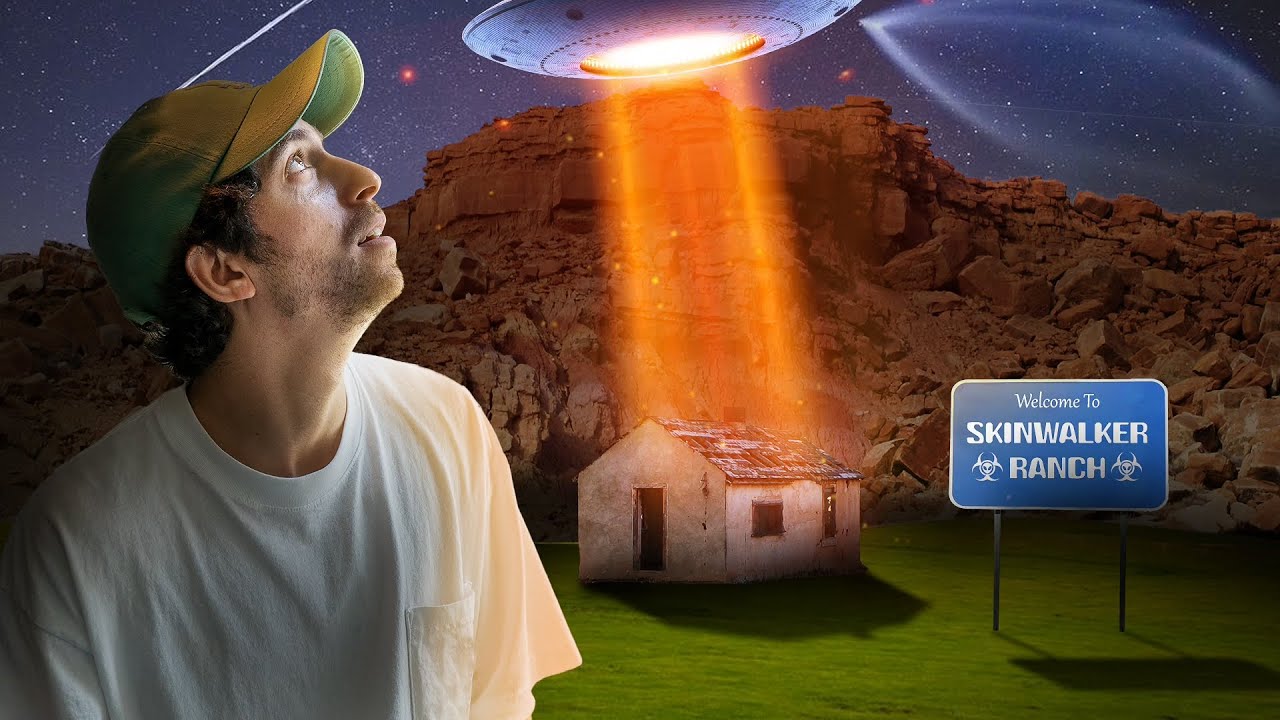
Skinwalker Ranch, located in Utah’s Uinta Basin, is considered one of the world’s most active paranormal hotspots, producing UFO sightings, orbs, cattle mutilations, electromagnetic anomalies, and serious biological effects on visitors. Brandon Fugal, a real estate mogul, now owns the property and has assembled a team of scientists to study the phenomena with modern sensors and plans to open-source the data — a sharp departure from earlier classified government research conducted there.
-
Historical backdrop and the “curse”: In the 19th century, the U.S. government allied with the Ute tribe against the Navajo. After the Navajo suffered a brutal defeat, they reportedly cursed the land with skinwalkers — malevolent shape-shifting entities often described as demonic werewolves. This origin story frames much of the lore around the property.
-
The Sherman family and Robert Bigelow: In the 1990s, the Sherman family took over the ranch and were essentially driven off after encountering orbs, UFOs, skinwalkers, and a massive bipedal wolf that allegedly survived a close-range shotgun blast. Their accounts attracted Robert Bigelow — the Budget Suites billionaire — who made UFO and paranormal research his life’s mission. Between 2007 and 2012, the ranch became the study site for ATIP, a government UFO program run under Bigelow Aerospace, making the data classified and exempt from FOIA. The only public records from this era come from two books: The Hunt for the Skinwalker and Skinwalkers at the Pentagon by Colm Kelleher, George Knapp, and James Lacatsky.
-
The cattle death and simultaneous UFO: A healthy two-year-old heifer was found dead with no exterior injuries, no predator tracks, and no sign of struggle. An autopsy revealed pneumonia brought on by a severe stressor that appeared to shock the animal. At the same moment, the team detected radiation levels near the cow higher than standing in front of a microwave. Surveillance footage showed a UFO-shaped object appearing directly above the cow the instant it reacted — a striking correlation the team acknowledges but stops short of calling definitive causation.
-
The buried metallic object under the mesa: Soil resistivity and ground-penetrating radar revealed a large metallic object roughly 400 feet wide buried beneath the mesa. A drill team led by Aaron Blunt hit a hard layer they couldn’t penetrate, even when attempting to drill upward. Hundreds of metal shards were recovered and analyzed by metallurgist Dr. Ravi Chandran, who determined the material was fused metal containing europium and tellurium — rare earth elements he concluded were likely manufactured, not naturally occurring. A snake camera attempt to visually confirm the object was blocked by a boulder.
-
The triangle zone and the rocket experiment: A patch of sky called “the Triangle” consistently tampers with equipment. The team launched a 15-foot rocket with GPS sensors and chalk to map or coat any invisible objects. The first rocket failed; the backup abruptly deflected westward as if avoiding something, with no wind present. At the exact same time, cameras captured a UFO moving in and out of the sky, seemingly provoked by the launch. High gamma radiation was also detected near the Triangle by the rocket’s EM detectors.
-
Biological effects on visitors — the George incident: On October 14, 2016, a group touring the ranch experienced severe effects. George, a six-foot-four former Hells Angel serving as security, stood frozen and unresponsive for roughly 10 minutes on top of the mesa. He later described “scope esthesia” — the sensation of being watched or targeted. He was hospitalized in Las Vegas, unable to walk for three to four weeks, with no biomarkers explaining his condition. That day, every member’s phone battery dropped from 80% to zero simultaneously. On the drive back, the group witnessed a silver-gray disc hovering about 100 feet above the mesa that moved 50 feet to the left in the blink of an eye, then darted away like a bullet.
-
Brain structure and predisposition to encounters: Researcher Michael Nolan (referenced as “Nolan”) has proposed that individuals with greater neural density in the basal ganglia — specifically between the caudate nucleus and the putamen — may be more predisposed to witnessing paranormal phenomena. The view is that this density exists prior to exposure rather than being caused by it, though some have suggested exposure might alter it.
-
Equipment anomalies and possible intelligent communication: GPS, EM sensors, LiDAR, and photogrammetry instruments consistently malfunction during scientific inquiry. In one striking incident, surveillance engineer Eric Barr monitored the control room camera remotely and, after verbally challenging whatever was triggering false motion alerts, captured a screen artifact that appeared to spell “LIVING” — the camera was labeled “trailer living room.” The team interprets this as possible evidence of a conscious, trickster-like entity communicating through cryptographic or symbolic means.
-
Theoretical framing — ancient AI and neural interfaces: One speculative framework presented is that the phenomena could involve ancient, artificially intelligent technology operating through a non-contact neural interface — essentially “pinging” humans in a handshake-like exchange. When human neurology fails to fully connect, the result manifests as what the episode calls “Skinwalker Ranch phenomenology.” This ties into broader questions about whether the phenomena are interdimensional, extraterrestrial, or something else entirely.
-
The “as above, so below” mystery: A rock engraving on the property bears the phrase “as above, so below,” with speculation it may be linked to Augustus Wally, a Buffalo Soldier and Medal of Honor recipient. The inscription raises the question of whether there is a correlation between what appears in the sky above the ranch and what is buried beneath it — connecting the UFO activity with the manufactured metallic object under the mesa.
-
Open questions and closing perspective: The episode closes by noting that Fugal does not call himself a “believer” but an “experiencer,” emphasizing direct observation over faith. The host, Jesse Michaels, suggests the field is over-indexed on empiricism and under-indexed on theory — that more sensors alone won’t solve the puzzle, and better theoretical frameworks are needed to make sense of the disparate anomalies.