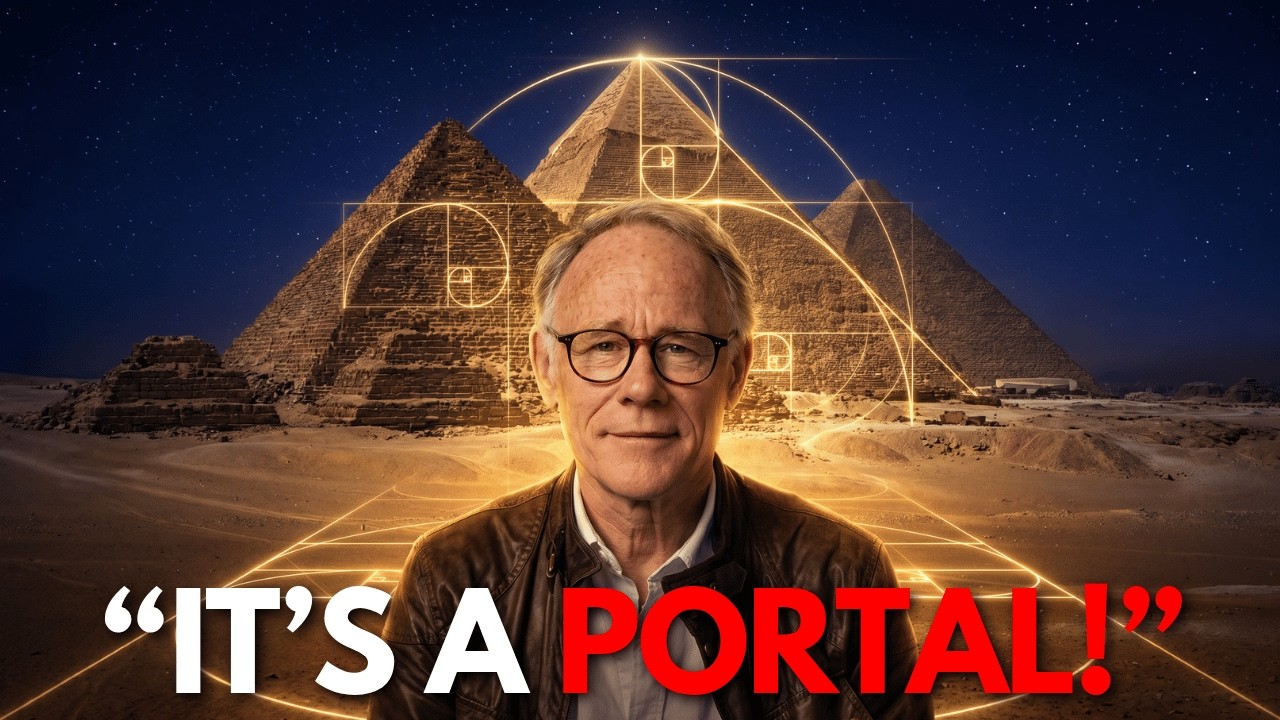
- Graham Hancock on the Great Pyramid as a portal for consciousness, not a tomb — Hancock returns to American Alchemy to argue that the Great Pyramid of Giza is a sophisticated device tied to the afterlife journey of the soul, connected astronomically to Orion’s Belt and the Milky Way, and built (or initiated) far more conventionally accepted dating suggests. He frames the episode around the idea that a lost Ice Age civilization passed down advanced astronomical and spiritual knowledge through secret societies and myth, and that mainstream archaeology actively suppresses this possibility.
Hancock’s origin story: from outsider to ancient-civilization investigator
- Hancock grew up across Scotland, South India, Northern Ireland, and northern England, feeling like an outsider from an early age; he clashed with the rigid doctrine of his English boarding school and was written off by teachers as a dreamer with no future.
- After excelling at university, he won a Leverhulme Foundation scholarship to live in Somalia (1975–1976), then built a career as a freelance journalist and The Economist’s East Africa correspondent based in Nairobi, with deep focus on Ethiopia.
- His investigation of the Ethiopian tradition that the Ark of the Covenant is kept in Axum (in Tigray province) became the gateway to his life’s work: interviewing the guardian monk who described the Ark as “a thing of fire,” noting the guardian’s cataracts and short lifespan, and encountering the Beta Israel (Ethiopian Jews) and their tradition of bringing the Ark to an island in the Nile and then to Lake Tana.
- Hancock says this was the first time he questioned whether archaeologists are trustworthy, because they dismiss the Ethiopian tradition despite its internal coherence and living faith.
The Great Pyramid: not a tomb, possibly thousands of years older than claimed
- No pharaoh’s burial has ever been found in any Egyptian pyramid; the Great Pyramid was completely empty when Caliph Mamun’s forces broke into it around 820 AD.
- Hancock and structural engineer Robert Bauval consider it impossible to build the 6-million-ton Great Pyramid in Khufu’s ~23-year reign; Hancock argues it was likely a project spanning hundreds or thousands of years, with the ancient Egyptians inheriting and completing a much older structure.
- The three ground platforms of the Giza pyramids are, in Hancock’s view, far older than the pyramids themselves and encode the epoch the Egyptians called Zep Tepi (“the first time”), astronomically linked to Orion’s Belt and to the Great Sphinx looking at the constellation Leo.
- The key astronomical match — Orion’s Belt due south at dawn on the spring equinox, with the Sphinx facing Leo — occurred roughly 12,500 years ago (around 10,500 BC), not 4,500 years ago.
- Hancock credits Robert Bauval with the Orion Correlation Theory and Robert Schoch (Boston University geologist) with the geological argument that the Sphinx’s water-erosion patterns indicate heavy rainfall consistent with the end of the last Ice Age, not 4,500 years ago; John Anthony West first brought Schoch to Giza.
- Hancock notes that modern Egyptology is heavily gatekept by the Egyptian Ministry of Antiquities and figures like Zahi Hawass, with whom he had a falling out in 2015 but has since reconciled over dinner, seeking “respectful disagreement” rather than smear campaigns.
Portals, Orion, and the worldwide journey of the soul
- Across North, Central, and South America, Orion’s Belt is consistently seen as the path of souls — the soul leaps to the Milky Way, undergoes challenges and judgment, and travels through an “underworld” that is also in the sky.
- Hancock points to the Great Pyramid’s shafts: the King’s Chamber shaft aligns with Orion, the Queen’s Chamber shaft with Sirius, suggesting a ritual purpose tied to the soul’s journey rather than burial.
- He argues this specific afterlife cosmology — not just generic life-after-death belief — appearing worldwide points to a common source passed down from a remote ancestor civilization at the end of the Ice Age.
- Similar “divine download” temple-building traditions appear across cultures: Gilgamesh receiving lapis lazuli tablets, Thutmose III, Aztec leaders, and Nebuchadnezzar all receiving instructions to build with specific astronomical alignments.
- Ptolemy (c. 100 AD) wrote that the soul’s ascension path is through Orion’s Belt, reinforcing the cross-cultural consistency of the idea.
Hermeticism and the transmission of secret knowledge across millennia
- Hancock cites Giorgio de Santillana and Hertha von Dechend (authors of Hamlet’s Mill) as having identified very ancient knowledge of precession (the ~26,000-year wobble of Earth’s axis).
- He argues that secret societies in ancient Egypt (the “followers of Horus,” the “souls of Ra and Nekhen”) were entrusted with preserving information from the “first time” and passing it down through myth and story, so that later cultures could decode it.
- The “switch on” of civilization around 3100–2500 BC happened simultaneously in Egypt, the Indus Valley, and Yellow River China, suggesting a shared inherited impulse from the end of the Ice Age.
- Atlantis, as told by Plato (who dated the destruction to 9600 BC via Egyptian priests at the Temple of Neith in Sais), is treated by Hancock as part of the global flood tradition — and that date corresponds to Meltwater Pulse 1B, a major sea-level rise event at the end of the Ice Age.
Archaeology as an institution vs. alternative researchers
- Hancock argues archaeology as an institution behaves like a “vampire” that drains the mystery from the past, insisting on a narrow weighing-measuring-counting approach and attacking outsiders.
- He draws a parallel to Heinrich Schliemann, the outsider who found Troy, and to Luis and Walter Alvarez, whose asteroid-impact theory for the dinosaur extinction was mocked until the Chicxulub crater was found.
- The same pattern, he says, applies to the Younger Dryas impact hypothesis (proposed by the Comet Research Group), which relies on the same kind of impact proxies (melt glass, shocked quartz, etc.) and points to a disintegrating comet impact ~12,800 years ago.
- Hancock stresses he has not “proved” a lost civilization — he is following curiosity and inviting others to investigate.
Aliens, UFOs, consciousness, and DMT research
- Hancock is skeptical of the “nuts and bolts” ancient-alien hypothesis but open to the idea that altered states of consciousness inspired ancient monuments.
- He recounts asking Peruvian shaman Pablo Amaringo why he painted UFOs in his visions; Amaringo replied they were “vehicles for entering and leaving the spirit world.”
- Modern DMT research at Imperial College London and UC San Diego uses intravenous DMT drips to keep volunteers in the peak state for up to an hour (DMT uniquely does not build tolerance), and volunteers consistently report encounters with “sentient others” who seem to have an urgent message.
- Ayahuasca (DMT + MAO-inhibiting vine) and yage (a different DMT/5-MeO-DMT brew) produce prolonged visionary states; Hancock describes his own yage experience as overwhelmingly powerful and filled with a sense of presence and communication.
- He argues that science is beginning to take these experiences seriously, and that ancient traditions (e.g., angel hierarchies in Thomas Aquinas and Iamblichus) may map the same realms accessed via DMT.
Nuclear weapons, leadership, and the need for consciousness change
- Hancock draws a parallel between the Ark of the Covenant’s “fire” and radiation damage, and notes UFOs’ reported association with nuclear bases; he suggests nuclear technology may represent another kind of “portal.”
- He is sharply critical of current world leaders, calling them “teenagers in old bodies” with “the power of gods” and no genuine leadership, and warns that nuclear-armed tribalism could bring self-inflicted planetary apocalypse.
- He invokes Oppenheimer’s famous line from the Bhagavad Gita — “I am become death, the destroyer of worlds” — and notes that ancient texts like the Vedas describe weapons that sound like nuclear devices, raising the question of whether earlier civilizations had such power.
- Hancock’s central hope is an elevation of consciousness across the human population, which he sees as the only way to avoid destruction.
Where to look for a lost civilization
- Hancock identifies the Sahara Desert (~9 million km², largely unexcavated and green during the Ice Age), the Amazon rainforest (where LIDAR is revealing huge geometrical earthworks and large pre-Columbian populations), and submerged continental shelves as the most promising places to search.
- He is intrigued by but not committed to the Richat Structure (Eye of the Sahara) as a possible Atlantis location, noting he has never been there.
- In the Amazon, 16th–17th century explorer accounts of large cities and earthworks are being confirmed by modern technology, vindicating Hancock’s approach of treating myth and tradition as guides to be ground-truthed rather than dismissed a priori.
- He also mentions the Tayos Cave in Ecuador (rumored to contain metallic tablets/library) and notes that Neil Armstrong visited it with a BBC crew in 1975 after the moon landing — a detail he finds intriguing but unresolved.