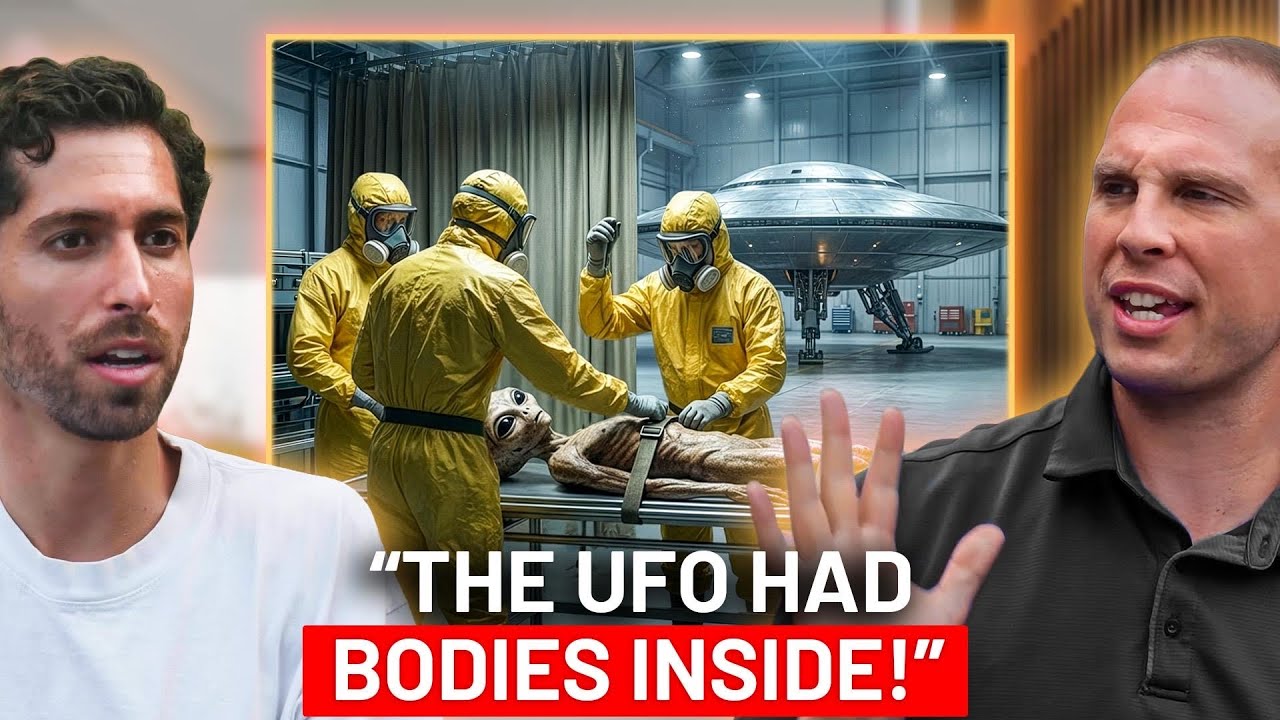
- David Grusch, a former 14-year high-ranking intelligence officer (NRO and Air Force), was detailed to the Pentagon’s Unidentified Anomalous Phenomena Task Force (UAPTF) in 2019 and later the All-domain Anomaly Resolution Office (AARO). What began as a routine assignment turned into the discovery of a deeply classified, decades-old crash-retrieval and reverse-engineering program — hidden from Congress, the public, and even from him as the UAPTF’s co-lead. After filing a formal whistleblower complaint with the Inspector General in summer 2022 (deemed “credible”), he went public in June 2023 and testified before Congress in July 2023, alleging the U.S. government possesses intact and partially intact non-human craft and non-human biological remains.
The secret program Grusch describes
- Grusch says a covert, multi-agency program — operating under Special Access Programs (SAPs) — has been retrieving crashed or landed non-human craft for decades and attempting to reverse-engineer them into functional human-piloted vehicles. He was systematically denied access to these programs despite his official UAPTF role, and colleagues who tried to bring him into the program described harsh treatment, threats of treason charges, and fear of Leavenworth or worse for anyone who disclosed it.
- He provided the Inspector General with names of individuals directly involved in the program, the aerospace companies participating, and the locations where craft are allegedly stored. He says the IG’s office found the complaint credible and shocking.
- Grusch confirmed publicly — in his NewsNation interview and under oath before Congress — that “biologics” (non-human remains, including pilots) have been recovered along with some of these craft. He declined to specify whether they were alive or dead, citing pre-publication review limits.
Why the secrecy, and how it was maintained
- Grusch traces the origin of UFO secrecy to the Manhattan Project era. He says the same ecosystem of nuclear secrecy — Special Access Programs, compartmentalization, and the Atomic Energy Act’s broad definition of “special nuclear material” (which could include radiologically exotic crash material) — was overlaid onto UFO recovery efforts. Oppenheimer and Manhattan Project-affiliated figures were central to establishing this classification framework.
- Project Blue Book, the Air Force’s public-facing UFO investigation of the 1950s–60s, was in Grusch’s account largely a propaganda effort to downplay the phenomenon while a real, deeper program operated in the shadows — likely under Atomic Energy Commission and later Department of Energy custody.
- Wright-Patterson Air Force Base in Ohio is identified as a key historical hub: it received Roswell debris (per Lt. Col. Jesse Marcel’s account), housed Blue Book, and later became a nuclear engineering and antigravity research center. Grusch recounts that even sitting senators and presidential candidates were denied access to rooms at Wright-Patterson where UFO material was kept.
The nuclear connection
- Grusch and the host discuss extensive testimony — compiled in Robert Hastings’ UFOs and Nukes — that UFOs have been repeatedly observed around nuclear weapons production, storage, and deployment sites (Hanford, Los Alamos, Malmstrom, Vandenberg, and others). Missileers have reported red glowing objects rendering ICBMs inoperable; photo instrumentation specialists recorded craft intercepting dummy nuclear warheads during Atlas V launches.
- The Air Force Office of Special Investigations reportedly confiscated footage and threatened witnesses in these cases. Grusch speculates nuclear activity may be an “attractant” for non-human intelligence, or that nuclear weapons development represents a threshold of interest to them — possibly because nuclear energy is a stepping-stone toward spacetime-manipulating propulsion.
Theories of propulsion and physics
- Grusch describes craft exhibiting isotopic ratios that would have to be engineered, suggesting materials not found naturally on Earth. He and the host discuss possible propulsion mechanisms: Alcubierre-type warp drives (folding spacetime), electromagnetic radiation effects (blue-shifted ultraviolet causing burns and neurological effects), and the possibility that craft ride spacetime waves rather than moving through space conventionally.
- The host raises the idea that fundamental physics breakthroughs in the mid-20th century — particularly in antigravity research — may have been classified and diverted into deep-black aerospace programs. Figures discussed include Louis Witten (father of string theorist Ed Witten), who worked on antigravity and topological physics at Martin Corporation’s Research Institute for Advanced Studies (RIAS) under George Trimble, and Townsend Brown, whose Biefield-Brown electrokinetic effect the host claims was later used in the B-2 stealth bomber.
- The host speculates that string theory may have functioned as a “bridge to nowhere” — mathematically elegant but empirically untestable — potentially diverting public-facing physics into a cul-de-sac while real breakthroughs remained classified.
Possible origins of non-human intelligence
- Grusch and the host consider several hypotheses for what the phenomenon represents:
- Extraterrestrial: visitors from other star systems.
- Time travelers: humans from the future visiting the past (the Mike Masters hypothesis), which would explain bipedal, childlike appearance and neoteny, as well as non-interventionist behavior (avoiding grandfather paradoxes).
- Higher-dimensional beings: the holographic principle and quasi-projection from higher-dimensional space could explain why “the inside is bigger than the outside” in some craft encounters.
- Cryptoterrestrial or other exotic origins are also acknowledged.
- Grusch stresses that intent is unknowable without access to the non-human intelligence’s decision-making loop. He cautions against anthropomorphizing — “don’t attack the zookeeper” — and argues the phenomenon does not appear to be an immediate existential threat.
Institutional dynamics and the path to disclosure
- Grusch argues the secrecy is now counterproductive to national security: compartmentalization prevents bringing in the best scientific talent (e.g., someone denied a clearance for marijuana use), and the program has not produced a working reverse-engineered vehicle (“if they did, we would own the skies”). He advocates for a disclosure framework modeled on nuclear physics — broad open study with weaponized applications classified.
- He notes that bipartisan congressional momentum (Schumer-Rubio UFO amendment, the 2023 hearing featuring Grusch, Ryan Graves, and Cmdr. David Fravor) reflects frustration with being shut out of the information. Rep. Matt Gaetz’s office was reportedly denied a SCIF to brief Grusch on an Eglin AFB UAP incident.
- Grusch directly addresses people still inside the program: there are legal channels (PPD-19, IGs, direct congressional disclosure), and he urges them to come forward as a legacy act. He frames transparency as essential to accountability — “if everything’s in secret, everybody can get away with things that might be illegal, unethical, immoral.”
Personal and cultural dimensions
- Grusch was diagnosed on the autism spectrum in his early thirties; he credits this with making him exceptionally effective at targeted intelligence work but acknowledges it complicated personal relationships and emotional expression. He also discussed PTSD from combat, including the death of a close friend, and his use of EMDR therapy and HRV breathwork to recover.
- The host and Grusch discuss how UFO experiences may have shaped religious and spiritual traditions (Saint Francis of Assisi’s stigmata as possible radiation damage, the Ariel school children’s telepathic contact), and how disclosure could reconcile science and religion. Grusch describes his own journey from agnosticism back to a belief in some form of higher sentience or creative intelligence.
- The episode closes with Grusch’s insistence that the phenomenon is real, that the cover-up has caused real harm (including, he implies, deaths of people connected to the program), and that the public deserves transparency — not for sensationalism, but because understanding the nature of reality is fundamental to human progress.